
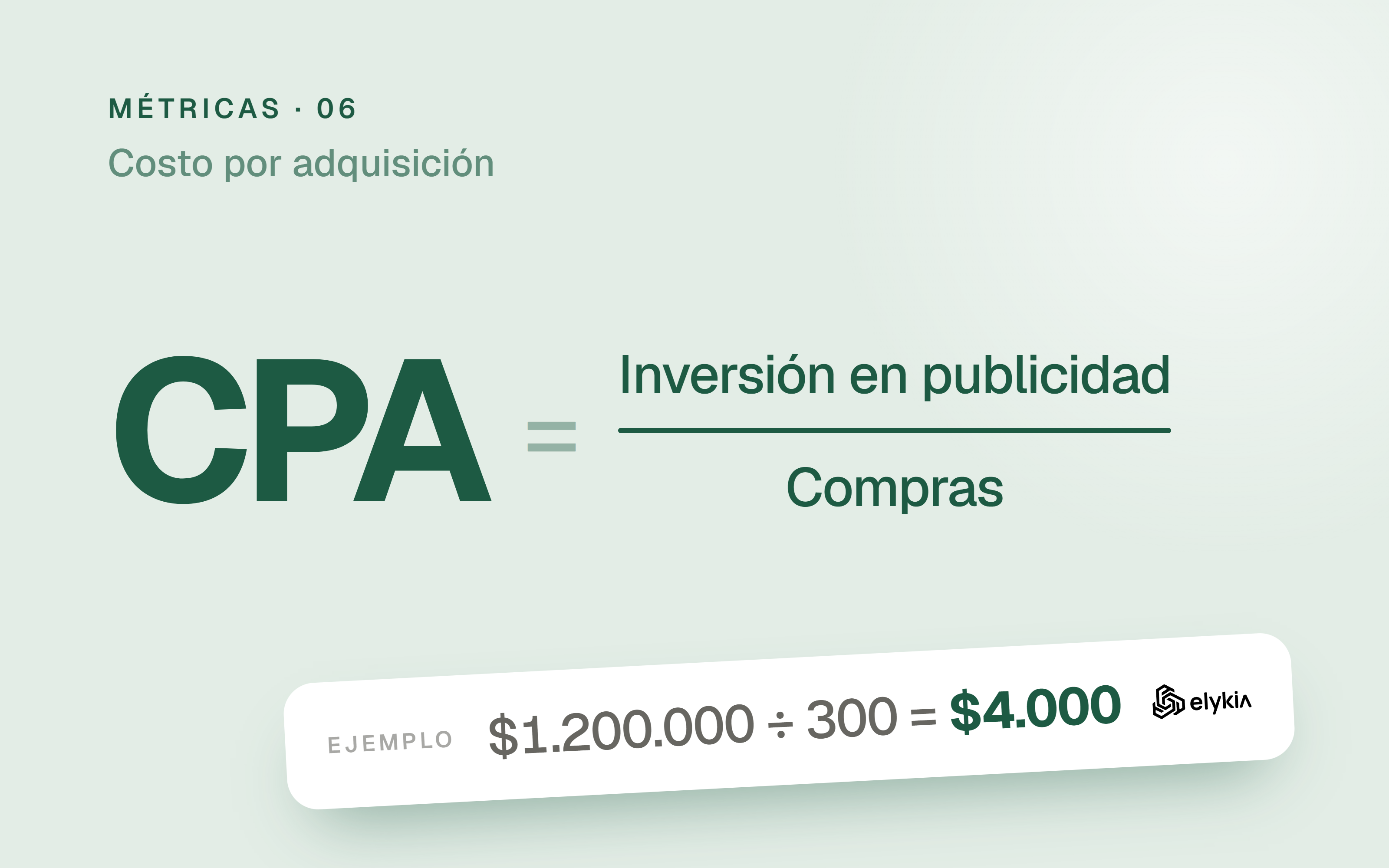
CPA (cost per acquisition, or cost per purchase) is how much each sale from your ads costs you, on average. To calculate it, divide your ad spend by the number of purchases.
The problem shows up when you want the CPA of each campaign, because then you're relying on what each platform reports. And the platforms claim more sales than they drove, miss purchases because of iOS and ad blockers, and lose track of people who switch devices.
The result: Meta tells you your campaign sells at $3.800 per purchase, when it actually costs you $6.000.
Summary
- CPA = ad spend ÷ purchases.
- CPA counts every purchase, including those from customers you already had. To know what a new customer costs you, the metric you want is CAC.
- If you calculate each campaign's CPA using the purchases Meta or Google report, the number doesn't reflect reality. We explain why below.
How do you calculate CPA?
CPA = ad spend for the period ÷ purchases for the period
- Ad spend: what you spent on ads during the period, adding up Meta, Google, TikTok and any other platforms.
- Purchases: every sale that came from your ads in that same period, from both new customers and people who were already buying from you.
In Meta you'll see it as "cost per purchase" or "cost per result," depending on how the campaign is set up. It's the most-watched metric in Ads Manager.
Example: CPA for a Shopify store
A Shopify store spends $1.200.000 in October on two campaigns and gets 300 purchases:
| Spend | Purchases | CPA | |
|---|---|---|---|
| Prospecting (new people) | $900.000 | 150 | $6.000 |
| Retargeting (people who already visited the store) | $300.000 | 150 | $2.000 |
| Total | $1.200.000 | 300 | $4.000 |
Looking at CPA alone, retargeting seems three times better than prospecting. But it mostly sells to people who already knew the store, and who in many cases would have bought anyway.
How is CPA different from CAC?
| CPA | CAC | |
|---|---|---|
| Divides by | All purchases | New customers only |
| Counts repeat purchases | Yes | No |
| What it's for | Seeing whether a campaign sells cheaply | Seeing whether your ads are growing your customer base |
Both come from the same ad spend, but they tell you different things. A campaign with a good CPA and a bad CAC is selling to your existing customers. We explain this in detail in CAC: What It Is and How to Calculate It.
What's a good CPA?
A CPA is good when each sale costs you less than you make from it. That limit is your break-even CPA: the most you can pay for a sale without losing money. It's the same idea as break-even ROAS, but in pesos per purchase.
In the example, the average order value is $25.000, and the store keeps 40% after product cost, VAT, fees and shipping (its contribution margin): $10.000 profit per purchase. That's its break-even CPA.
- Prospecting, with a CPA of $6.000, leaves $4.000 per purchase.
- Retargeting, with a CPA of $2.000, leaves $8.000 per purchase.
Both are below break-even, so both make money. What CPA doesn't tell you is how many of those purchases would have happened anyway without the ad.
And if all your campaigns are well below break-even, you're probably underspending: there's room to raise the budget even if CPA goes up a bit.
Why is the CPA Meta and Google show you wrong?
You can calculate your CPA for the whole business accurately using what you spent and your store's purchases. The problem shows up when you want it per campaign: then you depend on which sales each platform says it drove, and that breaks down for three reasons.
1. They claim extra sales. If someone saw your ad on Instagram, didn't click, and bought through Google the next day, Meta still claims that sale. So does Google. There was one sale; the reports show two. Meta comes set up this way by default, and almost every account leaves it that way.
In the example, the prospecting campaign sells at $6.000 per purchase. If Meta claims 157 purchases for every 100, its report shows roughly $3.800, and based on that number you'd scale a campaign that costs almost 60% more. We explain this in detail in The Same Sale, Counted Three Times.
2. They're missing data. Since iOS 14, and with ad blockers, the pixel sometimes doesn't see a purchase, and Meta fills in the gap with estimates. And if someone saw the ad on their phone and bought on their computer, the platform doesn't always know it's the same person.
3. Retargeting claims purchases that were going to happen anyway. Someone who already had the product in their cart and sees your ad before coming back to buy gets counted as a purchase from the campaign. That's why retargeting almost always has the lowest CPA in the account, even if it didn't convince anyone.
How can you see each campaign's CPA without Meta's inflation?
By connecting your store and your ad accounts to Elykia. It works with Tiendanube, Shopify, VTEX, WooCommerce and more.
It rebuilds each customer's journey, click by click, and sees what the platforms can't: purchases from iPhones, users with ad blockers, and device switches. It also counts each sale only once, even if the customer went through both Meta and Google.
With that, you get the real CPA for every channel, campaign and ad, with CAC right next to it, so you can see which campaign sells cheaply but doesn't bring in new customers. And in the same place, how much profit each campaign leaves you, the journey behind each purchase, and all of it ready for you to ask Claude about.
What you get with Elykia:
- More revenue on less spend. You cut the campaigns that only look like they sell cheaply and move that money to the ones that drive real purchases.
- Scale with confidence. Before raising the budget, you know what each purchase costs you and whether you're below break-even.
- Get better customers from Meta. You send back the sales Elykia tracks, and its algorithm learns from people who buy, not from clicks.
Frequently asked questions
Why does my CPA go up when I increase the budget?
Because the first purchases your ads bring in are the easiest ones: people who already knew you or were already looking for what you sell. As you spend more, your ads reach colder audiences. That's normal; what matters is that it stays below your break-even CPA.
CPA or ROAS?
It depends on your order value. If all your sales are for a similar amount, CPA is enough. If they vary a lot, look at ROAS: a campaign can have a high CPA, sell expensive products, and be making more money than another one with a low CPA.
Is CPA the same as cost per result?
Only if the campaign's result is a purchase. In Meta, "cost per result" depends on what you chose to optimize for: if it's a purchase, it's the CPA; if it's a message or a sign-up, it's something else.