
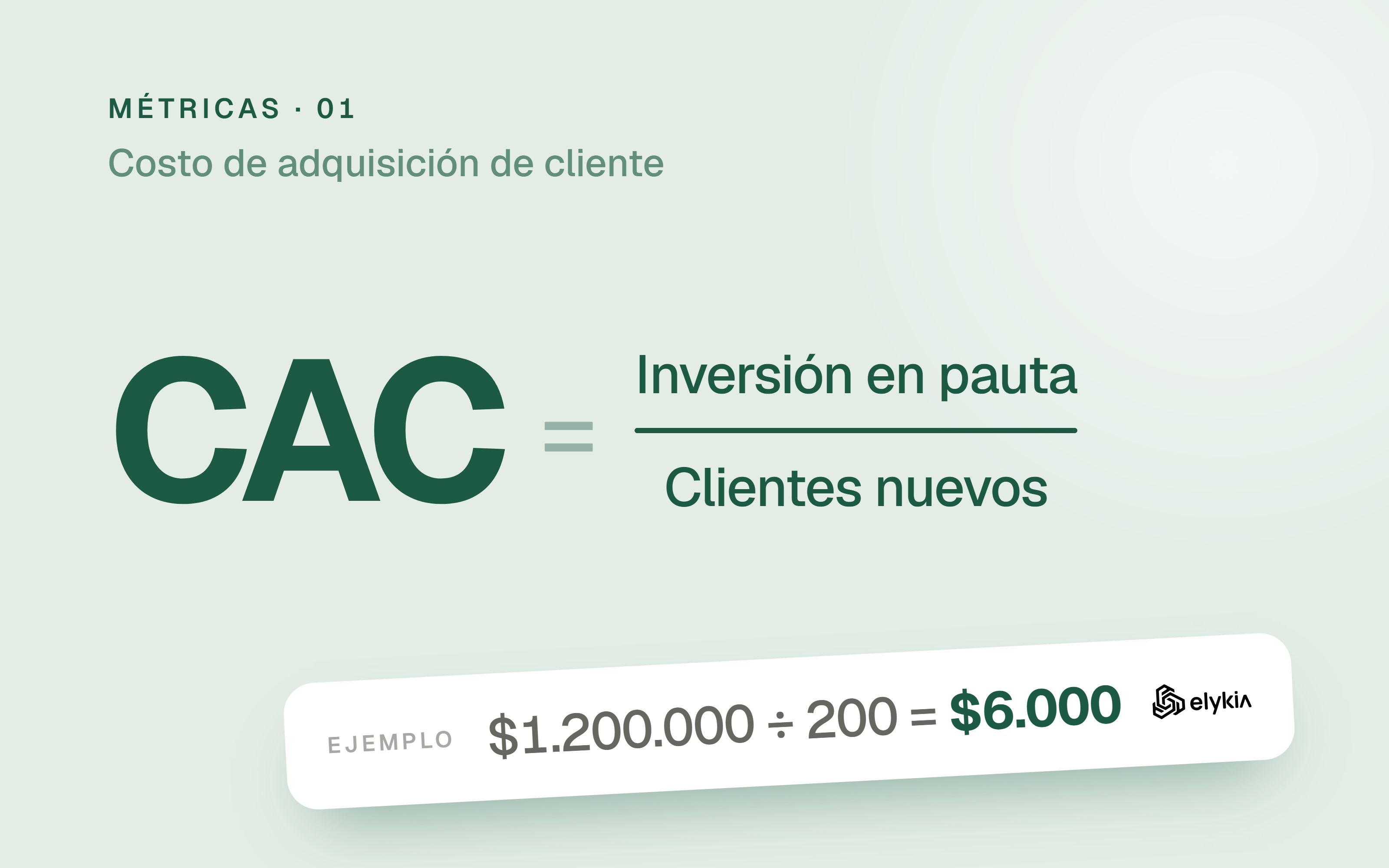
CAC (customer acquisition cost) is how much it costs you to get a new customer. You calculate it by dividing your ad spend by the number of customers who bought for the first time.
Sounds simple, and for your business as a whole, it is. The problem comes when you want the CAC for each channel or campaign: that's where you depend on the platforms, which claim more sales than they drove, lose purchases to iOS and ad blockers, and can't follow people who switch devices.
The result: Meta tells you your campaign brings in customers at $3.800, when they actually cost you $6.000.
In short
- CAC = ad spend ÷ new customers.
- Only first-time buyers count: if you divide by all purchases, that's CPA.
- If you calculate the CAC of each campaign using the numbers Meta or Google report, the number doesn't reflect reality. We explain why below.
How do you calculate CAC?
CAC = ad spend for the period ÷ new customers for the period
- Ad spend: what you spent on ads during the period, adding up Meta, Google, TikTok and the rest.
- New customers: people who bought for the first time in that same period. Each one counts once, even if they bought twice that month.
If you also add creators, your agency and tools, you get the fully loaded CAC, which gives you a more honest view of the business's health. The ad-spend-only version is the one you use to decide budget channel by channel. Pick one and don't mix them from one month to the next.
Example: CAC for a Tiendanube store
In October, a Tiendanube store spends $1.200.000 across Meta and Google and gets 300 purchases:
| October | |
|---|---|
| Ad spend | $1.200.000 |
| Total purchases | 300 |
| From new customers | 200 |
| From returning customers | 100 |
| Cost per purchase (CPA) = $1.200.000 ÷ 300 | $4.000 |
| Cost per new customer (CAC) = $1.200.000 ÷ 200 | $6.000 |
Both figures come from the same spend. CPA tells you how much you paid for each sale; CAC, how much you paid for each customer you didn't have before: $6.000, 50% more.
How is CAC different from CPA?
| CPA | CAC | |
|---|---|---|
| Divides by | All purchases | New customers only |
| Counts repeat purchases | Yes | No |
| What it's for | Seeing whether a campaign sells cheaply | Seeing whether your ads are growing your customer base |
A retargeting campaign can have a super low CPA because it sells to people who already knew you, and a sky-high CAC because it brings in almost no new customers. If you only look at CPA, you end up scaling whatever sells to your existing customers.
What's a good CAC?
One that's lower than the profit that customer leaves you. A $6.000 CAC is excellent for a furniture store and a disaster for a sock store.
In the example, the average order value is $25.000, and after product cost, taxes, fees and shipping, there's $10.000 in profit per purchase:
- With a $6.000 CAC, the first purchase pays for the ads and leaves $4.000.
- With a $12.000 CAC, the first purchase loses $2.000, and the store only makes its money back if the customer buys again.
The second scenario can be fine, but it's a bet on repeat purchases: make it knowing how often your customers come back. That's what LTV is for: the profit a customer leaves you across all their purchases. And to know whether a campaign makes money on today's sales, there's POAS.
Why is the CAC Meta and Google show you wrong?
You can calculate the CAC for your whole business correctly using what you spent and your store's new customers. The problem shows up when you want it per campaign: that's where you depend on which customers each platform says it brought in, and that breaks down for three reasons.
1. They claim more sales than they drove. If someone saw your ad on Instagram, didn't click, and bought through Google the next day, Meta still claims that sale. So does Google. It was one customer; the reports show two. Meta is set up this way by default, and almost every account leaves it that way.
In the example, Meta's ads bring in customers at $6.000. If Meta claims 157 sales for every 100, its report shows them at around $3.800, and with that number you'd scale a campaign that actually costs almost 60% more. We explain this in detail in The same sale, counted three times.
2. They're missing data. Since iOS 14 and with ad blockers, the pixel sometimes doesn't see a purchase, and Meta fills it in with estimates. And if someone saw the ad on their phone and bought on their computer, the platform doesn't always know it's the same person.
3. "Cost per purchase" isn't CAC. It's what the platforms show you, and it also counts people who were already your customers. In the example, it's the difference between $4.000 and $6.000.
How do you see CAC per campaign, without Meta's inflation?
By connecting your store and your ad accounts to Elykia.
It rebuilds each customer's journey, click by click, and sees what the platforms can't: purchases from iPhones, users with ad blockers, and device switches. It also counts each sale only once, even if the customer went through both Meta and Google.
With that, you get the real CAC for every channel, campaign and ad. And in the same place, how much profit each campaign leaves you, how much each customer leaves you with their repeat purchases, the journey behind every purchase, and all of it available to ask Claude about.
What you get with Elykia:
- Bring in more revenue while spending less. You cut the campaigns that only look cheap and move that money to the ones that bring in customers.
- Scale without fear. Before raising the budget, you know which campaign brings in new customers and at what cost.
- Get Meta to bring you better customers. You send back the sales Elykia tracks, and its algorithm learns from people who buy, not from clicks.
Frequently asked questions
How often should you measure CAC?
Once a month. Over shorter periods there are few new customers and the number jumps around a lot. If you spend a lot, you can look at it weekly, but make decisions based on the trend.
Why does my CAC go up when I increase my budget?
Because the first customers your ads bring in are the easiest ones: people who already knew you or were looking for what you sell. When you spend more, your ads reach colder audiences. That's normal; what matters is that it stays below what each customer leaves you.
How do I lower my CAC?
By improving your store's conversion rate, refreshing fatigued creatives, and shifting budget to the channels and ads with the lowest CAC. For that last one, you need to see it by channel, not just the average.