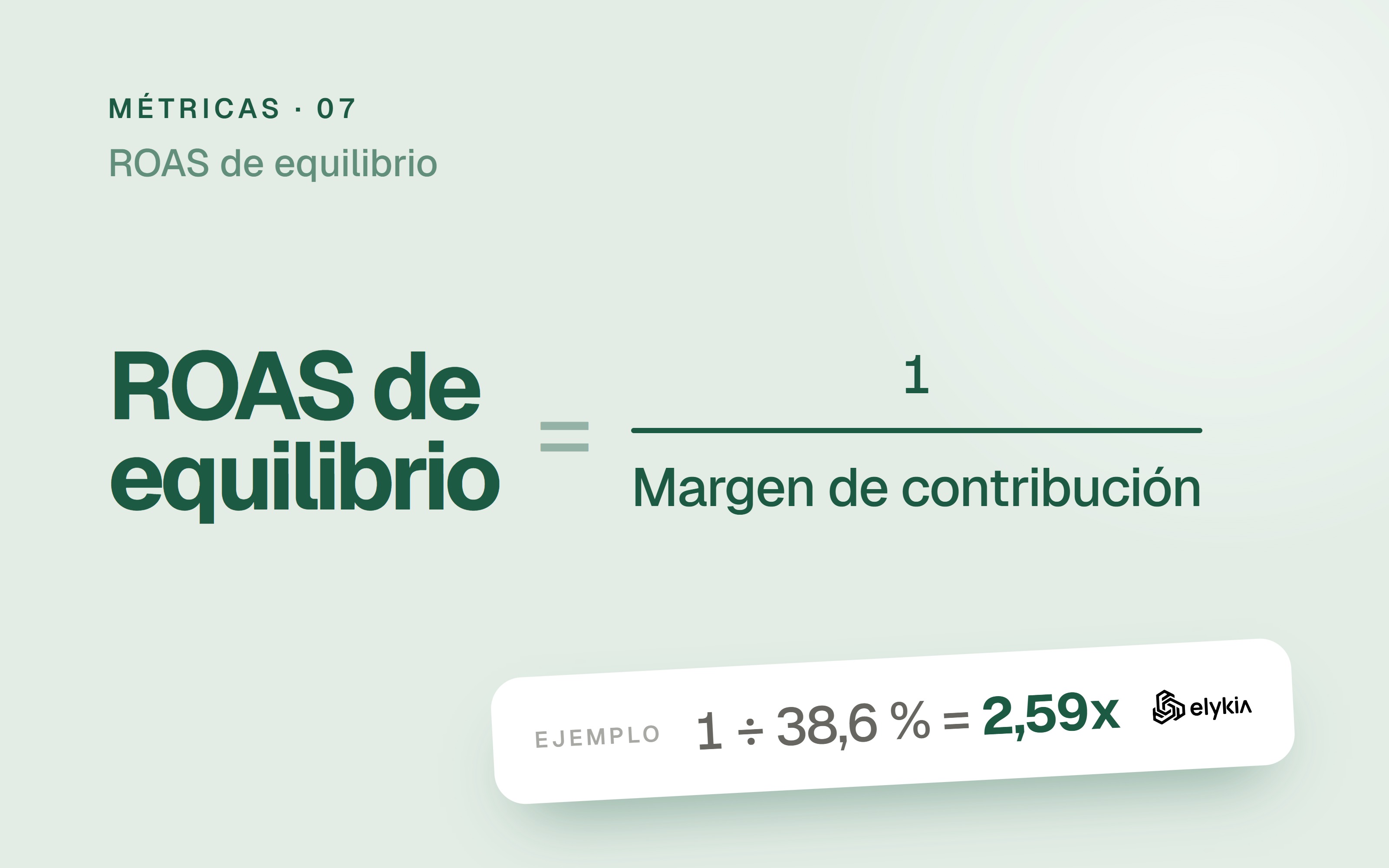
Break-even ROAS (also called ROAS breakeven) is the minimum ROAS a campaign needs to avoid losing money: at that number, what each sale leaves you covers exactly what you spent on ads. You calculate it by dividing 1 by your contribution margin.
It sounds simple, and the math is. The problem is what you compare it against: the ROAS each platform shows you is missing data (iOS, ad blockers, device switching), and on top of that, Meta and Google both claim the same sale.
The result: Meta tells you your campaign has a ROAS of 3.7x, well above your break-even, when it's actually 2.4x and losing money.
In short
- Break-even ROAS = 1 ÷ contribution margin.
- Break-even ROAS is the line between campaigns that make you money and campaigns that cost you money: below it you lose, above it you win.
- If you compare your break-even ROAS with the ROAS that Meta or Google report, the number doesn't reflect reality. We explain why further down.
How do you calculate break-even ROAS?
Break-even ROAS = 1 ÷ contribution margin
- Contribution margin: what you keep from each sale after paying everything it costs to make that sale: the product, VAT, fees, shipping and packaging. It's written as a proportion: 40% is 0.40.
- The result: how many pesos in sales each peso of advertising has to bring in so you don't lose money.
Breaking even isn't a ROAS of 1: it's your break-even ROAS. With a ROAS of 1, you bring in the same revenue you invested and lose everything the product, shipping and fees cost you. That's why, for a typical store, break-even sits well above 1.
Example: break-even ROAS for a Tiendanube store
An apparel store on Tiendanube sells a jacket for $50.000:
| Amount | % of price | |
|---|---|---|
| Sale price (incl. VAT) | $50.000 | 100% |
| Product cost | −$15.000 | 30% |
| VAT on the sale (21%) | −$8.678 | 17.4% |
| Mercado Pago fee (example: 6%) | −$3.000 | 6% |
| Shipping you absorb | −$3.000 | 6% |
| Tiendanube transaction fee (example: 1%) | −$500 | 1% |
| Packaging | −$500 | 1% |
| What you keep per sale | $19.322 | 38.6% |
| Break-even ROAS = 1 ÷ 0.386 | 2.59x |
For every $1 in advertising, the campaign has to bring in $2,59 in sales to avoid losing money. More than half the price is gone before you pay for a single ad.
Which costs go into the calculation?
Every cost that shows up each time you make a sale goes in, and none of the fixed ones:
| In | Out |
|---|---|
| Product cost | Salaries |
| VAT on the sale | Rent |
| Payment and platform fees | Tools and subscriptions |
| Shipping you pay for | Agency fees |
| Packaging | The advertising itself |
You pay fixed costs whether you sell or not. Break-even ROAS answers a different question: whether this campaign, on its own, loses money on every sale it brings in. To cover your fixed costs, your ROAS needs to be well above break-even.
What happens above and below break-even?
With the 2.59x break-even from the example, for every $10.000 in advertising:
| Campaign ROAS | What happens |
|---|---|
| 1.5x | You lose $4.200 |
| 2.59x | You break even: advertising eats up your entire margin |
| 3.5x | You make $3.500 |
| 5x | You make $9.300 |
The number you aim for, your target ROAS, is break-even plus the profit you want to get out of your advertising. And POAS gives you the same answer directly, because it already subtracts costs: anything above 1 means you're making money.
Why can't you find it in Meta or Google?
Because calculating it requires your margin, and the platforms don't know how much each sale costs you. And the ROAS you compare it against, the one they do show you, is off for three reasons.
1. They both claim the same sale. If someone saw your ad on Instagram without clicking and later bought through Google, both Meta and Google claim that sale. There was one sale; the reports show two.
With the break-even from the example, a campaign that truly has a ROAS of 2.4x is losing money. But if Meta claims 157 sales for every 100, it shows up in its report at 3.7x: it tells you the campaign is profitable and that you should scale it, when it's actually losing money. We explain this in The same sale, counted three times.
2. They're missing data. With iOS, ad blockers and device switching, the pixel sometimes doesn't see a purchase, and Meta fills it in with estimates.
3. Added together, they over-claim. Meta, Google and the rest together claim 88% of what stores bring in; Elykia attributes 58% to advertising.
How do you know whether each campaign is above your break-even?
By connecting your store (Tiendanube, Shopify, VTEX, WooCommerce and more) and your ad accounts to Elykia.
It reconstructs each customer's journey, click by click, and sees what the platforms don't: purchases from iPhones, users with ad blockers and device switching. It also counts each sale only once, even if the customer went through both Meta and Google.
With that, you get the real ROAS for every channel, campaign and ad, and how much profit each one leaves you: you can see at a glance which ones are above your break-even and which aren't. And in the same place, how much each customer is worth to you including repeat purchases, the journey behind every purchase, and all of it available to ask Claude about.
What you get with Elykia:
- Grow revenue while spending less. You cut the campaigns that are below your break-even and move that money to the ones that turn a profit.
- Scale with confidence. Before raising the budget, you know whether the campaign is truly above your break-even.
- Get better customers from Meta. You send back the sales Elykia tracks, and its algorithm learns from people who buy, not from clicks.
Frequently asked questions
What is ROAS breakeven?
It's the same as break-even ROAS, just phrased differently: the minimum ROAS your ads need so they don't lose you money. You calculate it the same way, by dividing 1 by your contribution margin; in this article's example, it comes out to 2.59x.
Is a ROAS of 1 breaking even?
No. A ROAS of 1 means bringing in the same revenue you put into ads, but out of that revenue you still have to pay for the product, VAT, fees and shipping. You only break even at your break-even ROAS, which for a typical store is above 2.
How often should you recalculate it?
Every time a major cost changes: your supplier's price, shipping, fees or your own sale prices. In Argentina, with inflation, it's a good idea to review it at least once a month.
What's a good break-even ROAS?
The lower, the better: it means you keep more margin from each sale and your advertising has more room to make money. A store with a 60% margin has a break-even of 1.67x; one with 25%, a break-even of 4x.