
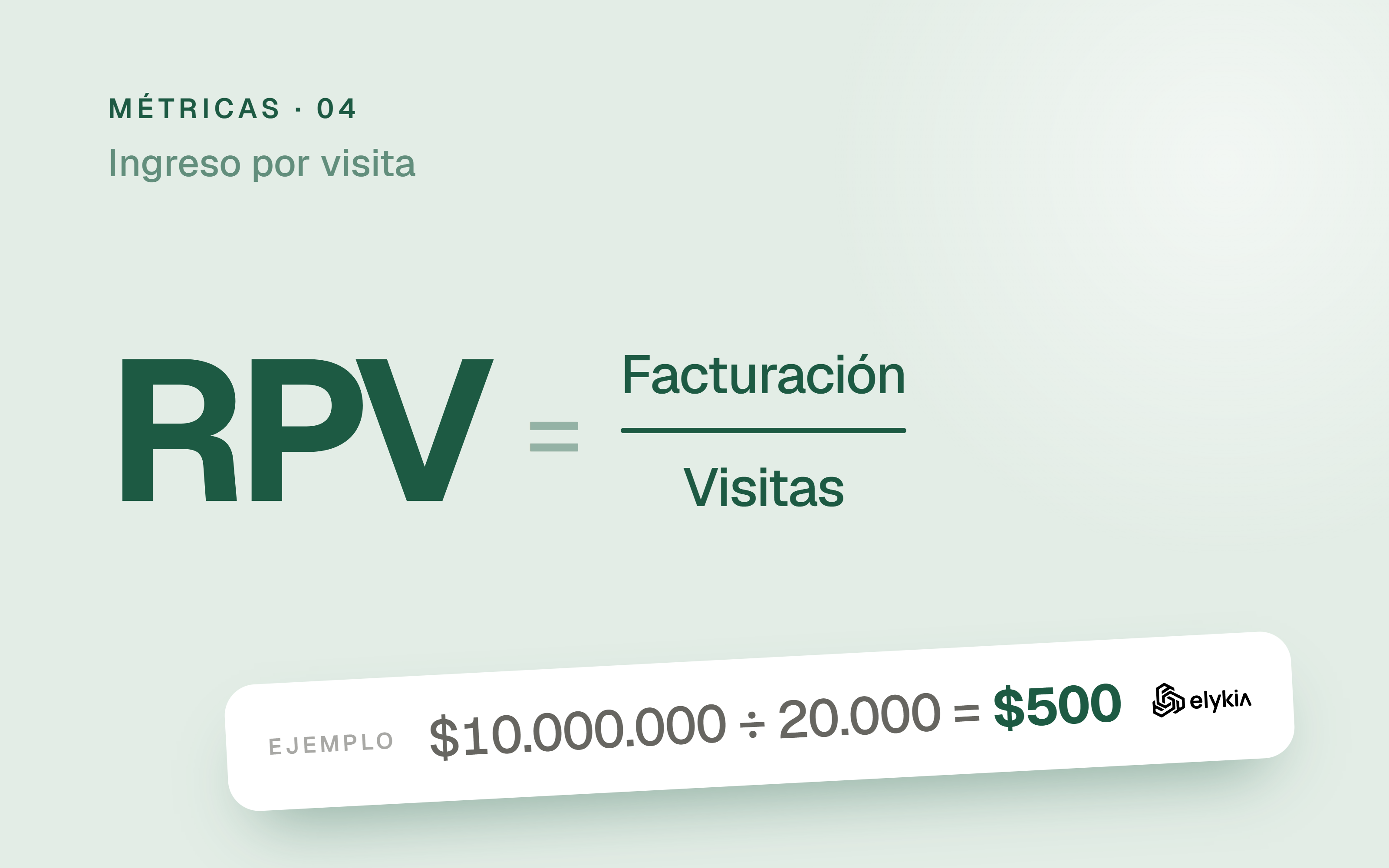
RPV (revenue per visit) is how much revenue you make, on average, from each visit to your store. You calculate it by dividing revenue by the number of visits.
It sounds simple, and for your store as a whole, it is. The problem starts when you want the RPV for each channel: then you depend on which sales each platform says it drove, and they claim more sales than they actually drove, miss purchases because of iOS and ad blockers, and lose track of people who switch devices.
The result: going by Meta's numbers, each visit it drives looks like it's worth $470, when it's really worth $300.
Summary
- RPV = revenue ÷ visits.
- RPV combines conversion rate and average order value into a single number: it tells you how much each visit is worth based on where it comes from.
- If you calculate each channel's RPV using the sales Meta or Google report, the number doesn't reflect reality. We explain why below.
How do you calculate RPV?
RPV = revenue for the period ÷ visits for the period
- Revenue: what you sold during the period. For a channel's RPV, the sales that channel drove.
- Visits: the number of times someone came to your store during the period. For a channel's RPV, the visits that came from that channel.
Another way to look at it: RPV = conversion rate × average order value. If 2 out of every 100 visits buy and each purchase is $25.000, each visit is worth $500 on average.
Example: RPV for a WooCommerce store
A WooCommerce store gets 20.000 visits in October and brings in $10.000.000 in revenue:
| Visits | Revenue | RPV | |
|---|---|---|---|
| Meta | 10.000 | $3.000.000 | $300 |
| 5.000 | $3.500.000 | $700 | |
| 2.000 | $2.000.000 | $1.000 | |
| Organic and direct | 3.000 | $1.500.000 | $500 |
| Total | 20.000 | $10.000.000 | $500 |
Each visit is worth $500 on average, but depending on where it comes from, it's worth anywhere from $300 to $1.000. Meta drives half the visits, and they're the ones that generate the least revenue.
How is RPV different from conversion rate?
| Conversion rate | RPV | |
|---|---|---|
| Measures | How many visits convert | How much revenue each visit generates |
| Accounts for order value | No | Yes |
| What it's for | Seeing whether your store persuades people | Comparing channels on the same yardstick |
A channel can convert poorly and still be worth a lot: if only a few people buy, but they buy big, its RPV is high. That's why, when deciding where to put your money, RPV tells you more than conversion rate alone.
What's channel-level RPV good for?
Knowing whether the visits you're paying for are worth it. A visit is worth it if what it earns you is more than what it cost to bring it in.
In the example, the store keeps $40 of every $100 it sells, a contribution margin of 40%:
- Meta: each visit brings in $300 and leaves $120 in profit. If it costs $140 to bring in, the store loses $20 per visit.
- Google: each visit brings in $700 and leaves $280 in profit. If it costs $120 to bring in, the store makes $160 per visit.
Looking only at how many visits each channel drives, Meta looks like the best. Looking at RPV, your money goes further on Google.
Why can't you find it in Meta or Google?
Because channel-level RPV needs two things: the visits each channel drove and the sales each one drove. No platform has both for all your channels, and what they do give you falls short for three reasons.
1. They claim more sales than they drove. If someone saw your ad on Instagram, didn't click, and bought through Google the next day, Meta still takes credit for that sale. So does Google. It was one sale; the reports show two. Meta is set up this way by default, and almost every account leaves it that way.
In the example, Meta's visits bring in $3.000.000. If Meta claims 157 for every 100, its report shows around $4.700.000, and each visit looks like it's worth $470 instead of $300. With that number, Meta goes from losing money on every visit to looking profitable. We explain it in detail in The same sale, counted three times.
2. They're missing data. Since iOS 14, and with ad blockers, the pixel sometimes doesn't see a purchase, and Meta fills it in with estimates. And if someone saw the ad on their phone and bought on their computer, the platform doesn't always know it's the same person.
3. Each one only sees its own. Meta doesn't know how many visits Google drove, and Google doesn't know how many email drove. To compare channels you need to measure them all on the same yardstick, and no platform can do that.
How do you see each channel's RPV without Meta's inflation?
By connecting your store and your ad accounts to Elykia. It works with Tiendanube, Shopify, VTEX, WooCommerce, and more.
It reconstructs each customer's journey, click by click, and sees what the platforms miss: purchases from iPhones, users with ad blockers, and device switches. It also counts each sale only once, even if the customer went through both Meta and Google.
With that, you get the real RPV for every channel, campaign, and ad, all measured on the same yardstick. And in the same place: how much profit each campaign leaves you, how much each customer is worth including repeat purchases, the journey behind every purchase, and all of it available to ask Claude about.
What you get with Elykia:
- Bring in more revenue while spending less. You shift money from the channels that drive visits that don't buy to the ones that drive visits that do.
- Scale without fear. Before raising your budget, you know how much each visit from each channel is worth.
- Get Meta to bring you better customers. You send it back the sales Elykia tracks, and its algorithm learns from people who buy, not from clicks.
Frequently asked questions
What counts as a visit?
Every time someone comes to your store and browses, even if they don't buy. If the same person comes in the morning and comes back at night, that's two visits. That's why RPV is measured per visit, not per person.
How do I increase RPV?
With two levers: getting more visits to buy (a better store, a better offer, fewer steps to check out) and making each purchase bigger (bundles and complementary products). And by moving your money to the channels that bring in higher-value visits.
RPV or ROAS?
Both. ROAS tells you how much comes back for every dollar you put into an ad. RPV tells you how much each visit is worth, and it also works for channels you don't pay for, like email or organic.