
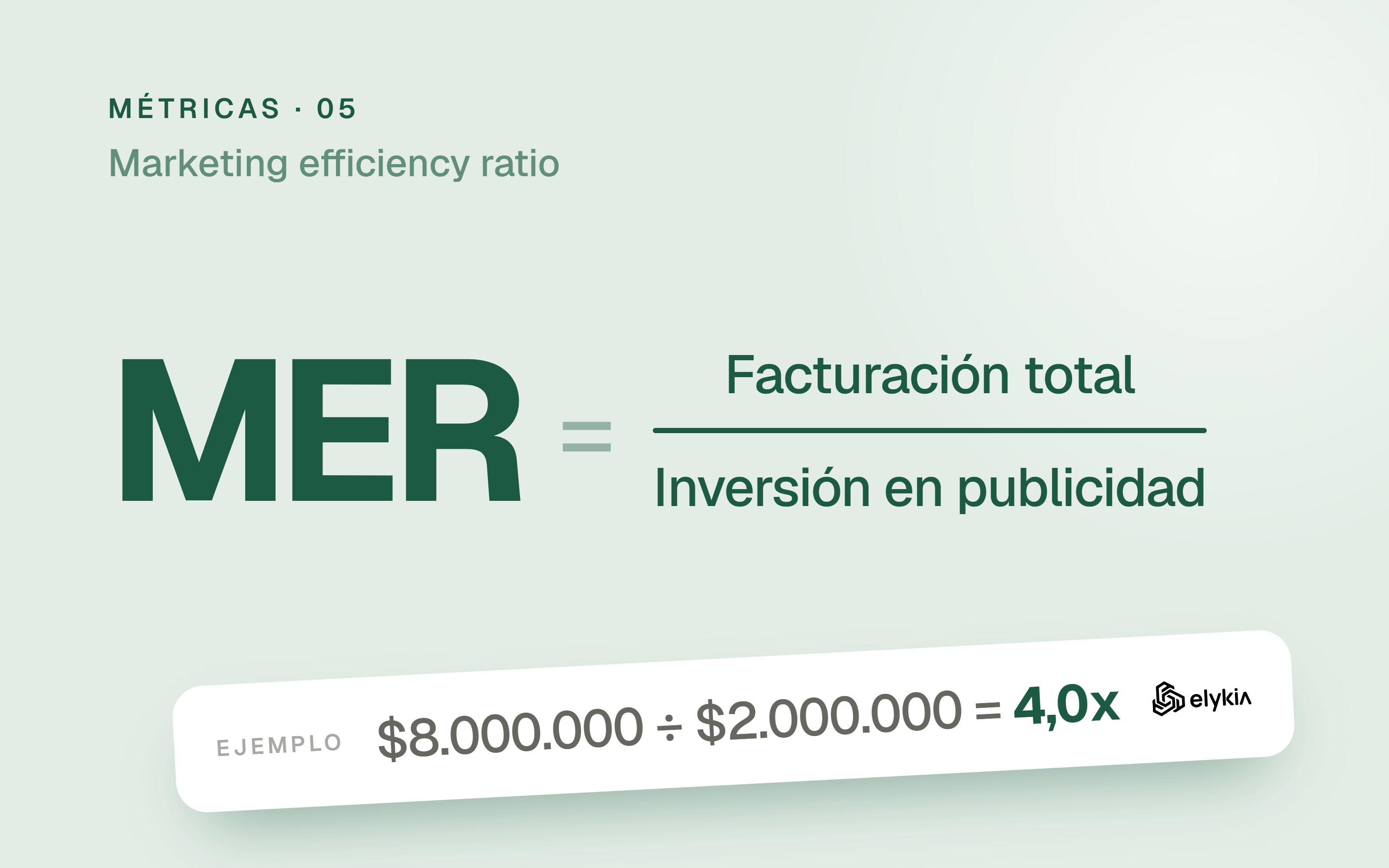
MER (marketing efficiency ratio) is how much total revenue you bring in for every $1 you put into advertising. You calculate it by dividing all your revenue by all your ad spend.
Its advantage is that it starts from what you actually sold, not from what each platform reports, so it's a 100% real number.
Its limitation is that it looks at all your advertising together: it doesn't tell you which campaign is working, and it also counts sales that come in through other channels, like email or organic.
The result: you know that for every $1 you spent on advertising you brought in $4, but not how much of that each campaign contributed.
Summary
- MER = total revenue ÷ total ad spend.
- MER doesn't depend on which sales each platform claims credit for. That's why it's the most honest way to see how well all your advertising performs together.
- If instead of calculating MER you add up the ROAS from Meta and Google, the number doesn't reflect reality. We explain why below.
How do you calculate MER?
MER = total revenue for the period ÷ total ad spend for the period
- Total revenue: everything you sold during the period, no matter where it came from: ads, email, organic, or people who came in directly.
- Total ad spend: what you spent on ads during that same period, adding up Meta, Google, TikTok, and the rest.
MER doesn't tell you which campaign is working: it tells you whether all your advertising together is paying off. To look at it campaign by campaign, you have ROAS.
Example: MER for a Tiendanube store
A Tiendanube store brings in $8.000.000 in October and spends $2.000.000 on advertising:
| October | |
|---|---|
| Total revenue | $8.000.000 |
| Meta spend | $1.400.000 |
| Google spend | $600.000 |
| Total ad spend | $2.000.000 |
| MER = $8.000.000 ÷ $2.000.000 | 4.0x |
For every $1 it put into advertising, the store brought in $4. That number includes sales that advertising didn't drive, like the ones from email or from people who came in directly.
How is MER different from ROAS?
| ROAS | MER | |
|---|---|---|
| Divides | Ad-driven sales ÷ spend | Total revenue ÷ total spend |
| Depends on which sales each platform claims | Yes | No |
| Can be broken down by campaign | Yes | No |
They complement each other. ROAS tells you which campaign to scale and which to cut, but it depends on how each sale gets credited. MER doesn't tell you that, but it can't lie to you: if it goes up, all your advertising together is performing better.
What's a good MER?
Neither too low nor too high.
Too low means your advertising isn't paying for itself. To find where that floor is, compare it with your contribution margin: what you keep from each sale after product cost, VAT, fees, and shipping.
In the example, the store keeps $40 out of every $100 it sells, a 40% margin. With a 4.0x MER, every $1 of advertising brings in $4 in revenue and $1,60 in profit:
- Advertising pays for itself and leaves $0,60 for every $1 spent.
- If MER dropped to 2.5x, every $1 of advertising would bring in $1 in profit: advertising would break even.
Too high isn't great news either: it usually means you're underinvesting. If every $1 leaves plenty of profit, you could probably spend more and sell more, even if MER drops a bit. In the example, the store has room for that: even if MER fell from 4.0x to 2.5x, advertising would still pay for itself.
Rather than focusing on one month's number, watch how it moves. If you spend more and MER holds, you scaled well. If you spend more and MER drops, the new money is performing worse than what you were spending before.
Why doesn't adding up what Meta and Google report work?
Because MER needs all your revenue and all your spend, across every platform, and each platform only knows its own. And if you try to build it by adding up their reports, it breaks down for three reasons.
1. They claim the same sales. If someone saw your ad on Instagram, didn't click, and bought through Google the next day, Meta claims that sale and so does Google. There was one sale; the reports show two.
In the example, Meta says its ads brought in $6.700.000 and Google says $2.100.000. Together that's $8.800.000: more than the store's revenue for the entire month, including email and organic. We explain this in detail in The same sale, counted three times.
2. They're missing data. Since iOS 14, and with ad blockers, the pixel sometimes doesn't see a purchase, and Meta fills it in with estimates. And if someone saw the ad on their phone and bought from their computer, the platform doesn't always know it's the same person.
3. Each one only sees its own data. Meta doesn't know how much you spent on Google or how much your email sold. For MER you need everything together, and no platform has it.
How can you see your business's MER without building spreadsheets?
By connecting your store and your ad accounts to Elykia. It works with Tiendanube, Shopify, VTEX, WooCommerce, and more.
It pulls together all your revenue and all your spend, across every platform, and calculates MER automatically, day by day. It also reconstructs each customer's journey, click by click, and counts each sale only once, even if it went through both Meta and Google.
With that, you get your business's MER and, right next to it, the ROAS of every channel, campaign, and ad measured by the same yardstick, so you know what's pushing MER up or down. And in the same place, how much profit each campaign leaves you, the journey behind every purchase, and all of it available to ask Claude about.
What you get with Elykia:
- Sell more while spending less. You see whether the new money you put into advertising pays off or just drives up spend.
- Scale with confidence. You raise your budget by watching how MER moves, not what each platform says.
- Get Meta to bring you better customers. You send back the sales Elykia tracks, so its algorithm learns from people who buy, not from clicks.
Frequently asked questions
MER or ROAS?
Both, for different questions. MER tells you whether all your advertising together is paying off; ROAS tells you which campaign to scale and which to cut. If your campaigns' ROAS goes up but MER doesn't, some platform is claiming sales it didn't drive.
Does MER include sales that don't come from advertising?
Yes, and that's on purpose. Ads also drive sales that come in through other channels: someone who saw your ad and later searched for you on Google or came in directly. MER counts all of them and doesn't have to decide where each one came from.
How often should you check MER?
Weekly, and make decisions based on the trend over several weeks. A single day can go up or down because of a promo or a holiday, without anything changing in your advertising.