
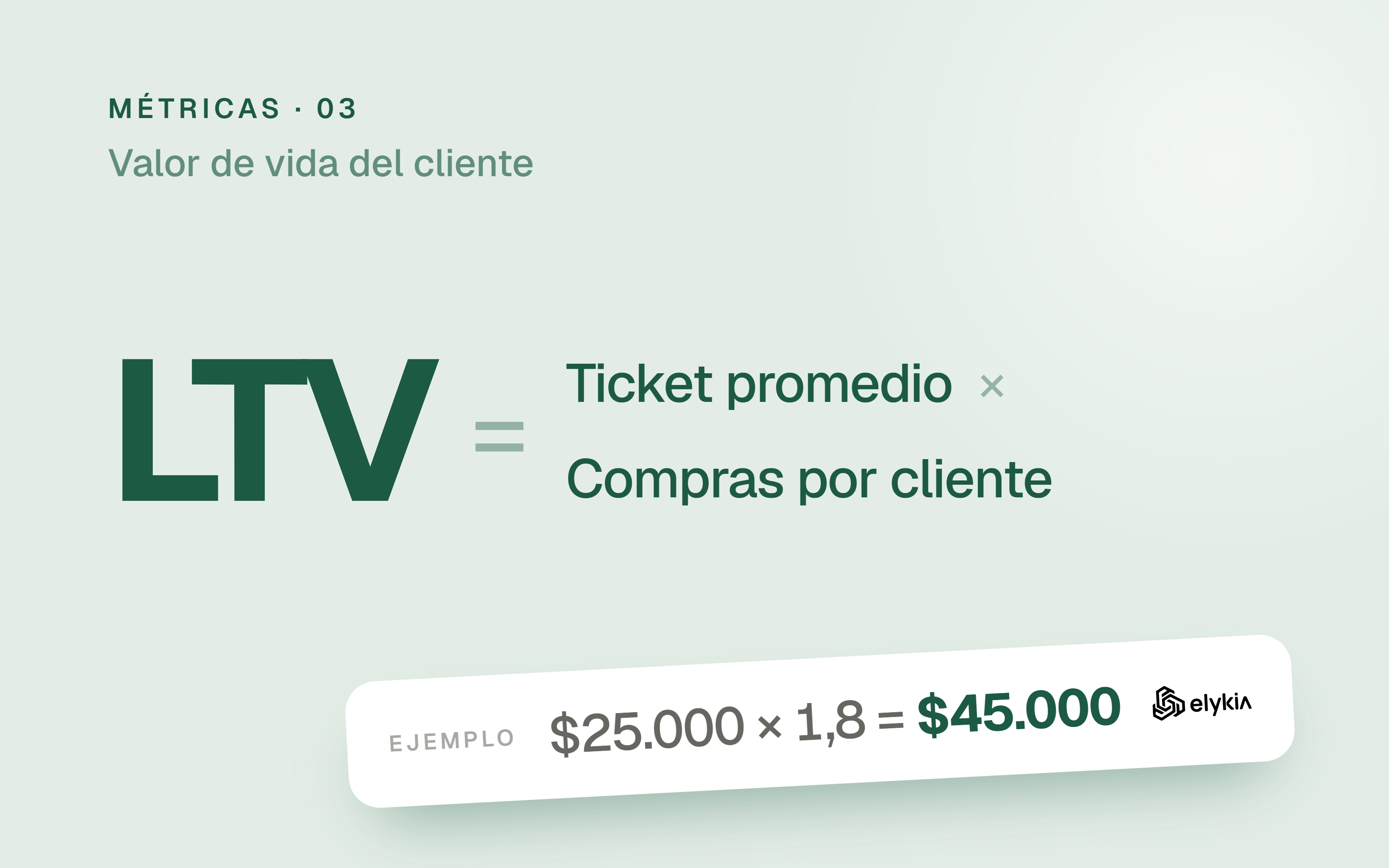
LTV (customer lifetime value) is how much a customer buys from you across all their purchases, not just the first one. You calculate it by multiplying average order value by the number of times they buy.
Its advantage is that it tells you what a customer is really worth, including the purchases they make months after the first one.
Its limitation is that it takes time to show up: you need several months of history to know how often your customers come back to buy. And to know the LTV of the customers each campaign brings in, you have to tie every purchase to the ad it came from.
The result: you know each customer buys $45.000 from you in a year, even though on their first purchase you only saw $25.000.
Summary
- LTV = average order value × purchases per customer.
- LTV tells you what a customer is worth beyond their first purchase, and with that, how much you can pay to acquire them.
- If you calculate LTV using what Meta or Google report, the number doesn't reflect reality. We explain why below.
How do you calculate LTV?
LTV = average order value × purchases per customer in the period
- Average order value: what a customer spends, on average, each time they buy.
- Purchases per customer: how many times they buy, on average, in the period you choose. Looking at 12 months is the most common.
Example: the LTV of a VTEX store
A VTEX store looks at the customers who bought for the first time a year ago:
| Last 12 months | |
|---|---|
| Average order value | $25.000 |
| Purchases per customer | 1.8 |
| LTV = $25.000 × 1.8 | $45.000 |
Each customer buys, on average, $45.000 from the store in a year. If it only looked at the first purchase, it would think each customer is worth $25.000: almost half.
What's a good LTV?
An LTV is good when it's well above what it costs you to acquire that customer, which is your CAC. How much higher depends on your margin, because of what a customer buys from you, only part of it is left over to pay for advertising.
In the example, the store has a 40% margin: of the $45.000 each customer buys, it keeps $18.000. That's the most it can pay for a customer without losing money.
- With a CAC of $6.000, each customer leaves 3 times what they cost. Advertising pays off.
- With a CAC of $15.000, each customer barely covers what it cost to acquire them. You need to improve repeat purchases or lower what you pay per customer.
- With a CAC of $2.000, each customer leaves 9 times what they cost. Sounds great, but you're probably underinvesting: you could pay more per customer and get a lot more of them.
Why doesn't it work to calculate it with what Meta and Google report?
Because each platform only sees part of your customers' journey. This happens for three reasons.
1. They only see the first purchase. Meta counts purchases that happen a few days after the ad. The repeat purchase three months later, which comes in through an email or by someone going straight to your store, it doesn't see. In the example, Meta records the $25.000 from the first purchase and misses the other $20.000 for the year.
2. They're missing data. Since iOS 14, and with ad blockers, sometimes the pixel doesn't see a purchase, and Meta fills it in with estimates. And if someone saw the ad on their phone and bought from their computer, the platform doesn't always know it's the same person.
3. They claim extra customers. If someone saw your ad on Instagram, didn't click, and later bought through Google, Meta and Google both claim the same customer. If you build each channel's LTV with those numbers, the same customer shows up in two places.
We explain it in detail in The same sale, counted three times.
How do you see your customers' LTV with all their repeat purchases?
By connecting your store and your ad accounts to Elykia. It works with Tiendanube, Shopify, VTEX, WooCommerce, and more.
It rebuilds each customer's journey, click by click, and brings all their purchases together, even if they come back months later through a different path. It also sees what the platforms don't: purchases from iPhones, users with ad blockers, and device switches.
With that, you get your customers' LTV, including gross-profit LTV, how many come back to buy, and how much each one leaves you compared to what they cost. And in the same place, the CAC of each campaign, the journey behind each purchase, and all of it ready to ask Claude about.
What you get with Elykia:
- Sell more while spending less. You stop cutting campaigns that look expensive but bring in customers who come back to buy.
- Scale without fear. You know how much you can pay for a customer before raising the budget.
- Get Meta to bring you better customers. You send back the sales Elykia tracks, and its algorithm learns from people who buy, not from clicks.
Frequently asked questions
How often should you measure LTV?
Every three months is enough. LTV moves slowly, because it depends on how often your customers come back to buy, and that takes time to show up. Looking at it every week won't tell you anything new.
How do I increase LTV?
There are three common levers: getting customers to buy again (emails, replenishment of products that run out, loyalty programs), getting them to spend more on each purchase (bundles and complementary products), and getting more margin out of each sale.
Is LTV the same as average order value?
No. Average order value is what a customer spends on one purchase. LTV adds up all their purchases over time, and in its gross-profit version, it subtracts costs. A store with a low average order value can have a high LTV if its customers come back often.