
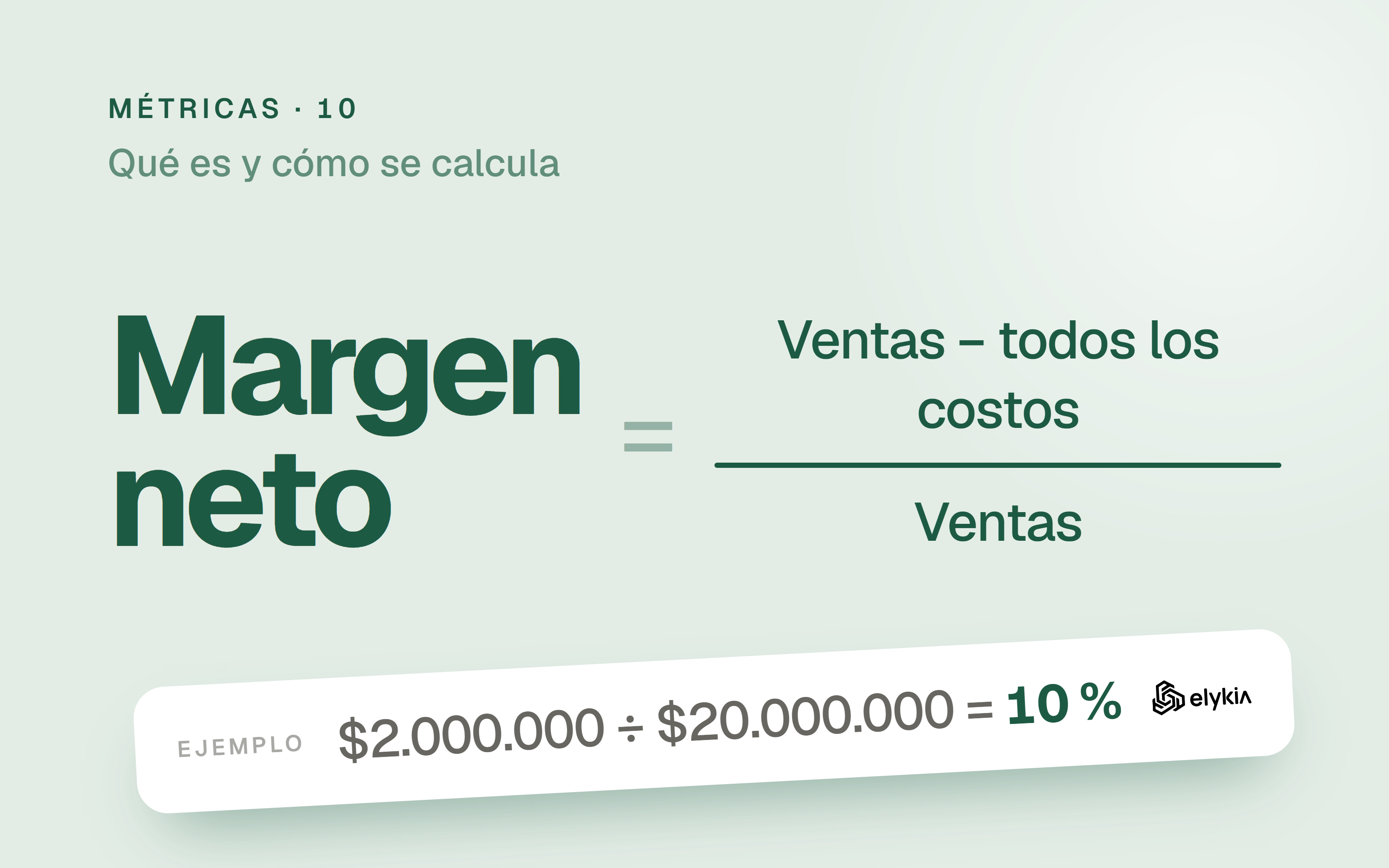
Net margin is the share of what you sold that your business keeps after paying for everything: products, fees, shipping, advertising and fixed costs. You calculate it by subtracting all your costs from sales and dividing by sales.
It sounds simple, but it's the number people look at least: day-to-day reports talk about sales and ROAS, and profit only shows up at the end of the month, if it shows up at all.
The result: the month looks great because you sold $20 million, when the business actually kept $2 million: 10%.
Summary
- Net margin = (sales − all costs) ÷ sales.
- It's the only margin that subtracts advertising and fixed costs like salaries, rent and tools: it tells you whether your business is making money.
- A good ROAS doesn't guarantee a good net margin, and the ROAS the platforms report doesn't reflect reality. We explain why below.
How do you calculate net margin?
Net margin = (sales − all costs) ÷ sales
- Sales: what you sold in the period, excluding VAT.
- All costs: variable costs (products, payment fees, shipping and packaging), advertising, and fixed costs (salaries, rent, tools and services).
You calculate it per period, almost always per month. In pesos it's called net profit; divided by sales, it's net margin.
Example: net margin for a WooCommerce store
A home decor store on WooCommerce closes the month like this:
| Amount | % of sales | |
|---|---|---|
| Monthly sales (excluding VAT) | $20.000.000 | 100% |
| Cost of products | −$6.000.000 | 30% |
| Payment processing fees | −$1.200.000 | 6% |
| Shipping and packaging | −$1.400.000 | 7% |
| Advertising | −$4.000.000 | 20% |
| Fixed costs (salaries, rent, tools) | −$5.400.000 | 27% |
| Net profit | $2.000.000 | 10% |
For every $100 it sold, it kept $10. The other $90 went to product, fees, shipping, advertising and fixed costs.
How is it different from gross margin and contribution margin?
| Gross margin | Contribution margin | Net margin | |
|---|---|---|---|
| Subtracts from sales | Only the cost of the product | All variable costs | Variable costs, advertising and fixed costs |
| In the example | 70% | 57% | 10% |
| What it's for | Comparing products | Deciding how much you can spend on advertising | Knowing whether the business makes money |
All three start from the same sales and subtract more and more costs. That's why net margin is always the lowest of the three, and the only one that tells you how much you actually made.
What's a good net margin?
There's no one-size-fits-all number: it depends on your category, your business's stage and how much you're investing to grow. What you can see is what moves it, and in e-commerce, what usually moves it most is advertising:
| Advertising (% of sales) | Net margin |
|---|---|
| 25% | 5% |
| 20% (the example) | 10% |
| 15% | 15% |
With the same sales, every point of advertising you save is one more point of net margin. That ratio of advertising to sales is the inverse of MER: a 5x MER means spending 20% of what you sell on advertising.
Why can a good ROAS end up in a low net margin?
Because ROAS only looks at sales, while net margin looks at everything those sales cost you. On top of that, the ROAS Meta shows you is inflated. It falls short for three reasons.
1. ROAS doesn't see your costs. A 3x ROAS says that for every $100 in advertising you sold $300. It doesn't say that $129 of those $300 goes to product, fees and shipping, and that you still have to pay salaries and rent out of what's left.
2. They both claim the same sale. If someone saw your ad on Instagram without clicking and later bought through Google, Meta and Google both claim that sale. There was one sale; the reports show two.
In the example, advertising brought in $12 million: a real ROAS of 3x, where every $100 spent leaves $71 to cover fixed costs. Meta shows you 4.7x, and with that number it looks like $168: more than double. We explain it in The same sale, counted three times.
3. They're missing data. Between iOS, ad blockers and people switching devices, the pixel sometimes misses a purchase and Meta fills it in with estimates.
How can you know your net margin without waiting until the end of the month?
By connecting your store (Tiendanube, Shopify, VTEX, WooCommerce and more) and your ad accounts to Elykia.
It matches every sale with what it cost you: the product, shipping, the fees for each payment method and taxes, and then subtracts advertising and your fixed costs. It also reconstructs each customer's journey, click by click, and counts every sale only once, even if it went through both Meta and Google.
That gives you your up-to-date net profit, plus what each channel, campaign and ad is leaving you. And in the same place, how much each customer brings in with their repeat purchases, the journey behind every purchase, and all of it ready for you to ask Claude about.
What you get with Elykia:
- Sell more while spending less. You see which campaigns are eating your profit and move that money to the ones that are generating it.
- Scale with confidence. Before raising your budget, you know how much the business will keep.
- Get better customers from Meta. You send back the sales Elykia tracks, so its algorithm learns from people who buy, not from clicks.
Frequently asked questions
Are net margin and net profit the same thing?
They measure the same thing in two ways. Net profit is in pesos: what the business kept. Net margin is a percentage: what share of what you sold is profit.
How often should I calculate it?
At least once a month. If you're changing your ad spend a lot, it's worth checking every week: that's where you'll first notice whether scaling is leaving you more money or just more sales.
How do I increase my net margin?
There are four common levers: raising the margin on each sale (prices, suppliers, shipping), pulling ad spend from campaigns that don't generate profit, cutting fixed costs, and selling more to customers who've already bought, since they don't cost you advertising.