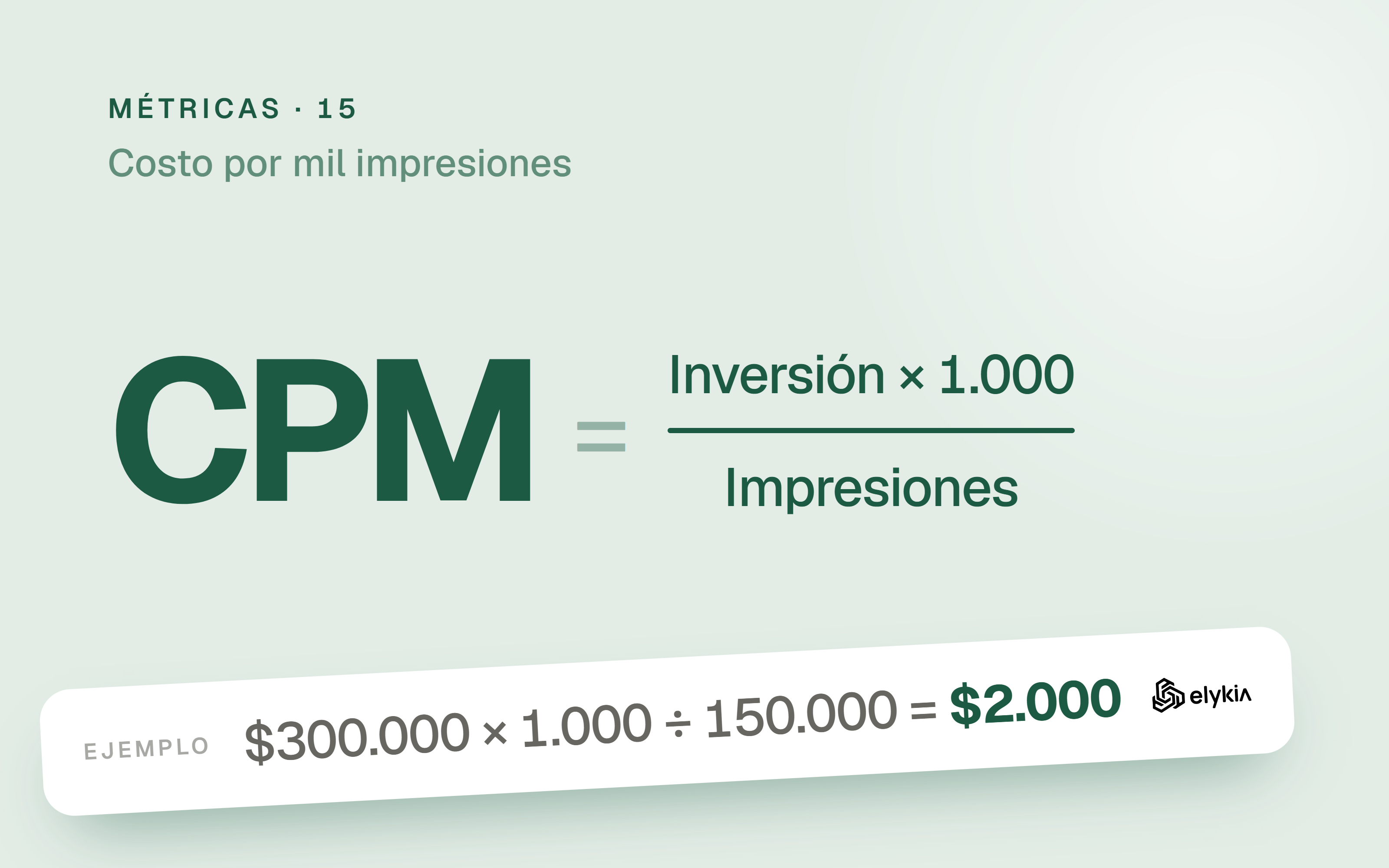
CPM (cost per thousand impressions) is how much you pay to have your ad shown a thousand times. You calculate it by dividing your ad spend by your impressions and multiplying by a thousand.
Its upside is that it's an exact number: Meta and Google know how many times they showed your ad. Its limitation is that it measures how much it costs to get seen, not to get bought from.
Bottom line: you know how much it costs you to reach people, but the ad that's cheapest to show can be the one that's most expensive at selling.
Summary
- CPM = ad spend ÷ impressions × 1,000.
- CPM measures the cost of showing your ad; CPC, the cost of getting someone to click.
- If you pick ads based on their CPM, you end up scaling the ones that don't sell. We explain why below.
How do you calculate CPM?
CPM = ad spend for the period ÷ impressions for the period × 1,000
- Ad spend: what you spent on the ad, campaign, or account during that period.
- Impressions: the number of times the ad appeared on a screen. If the same person sees it three times, that's three impressions.
You multiply by a thousand because a single impression is worth fractions of a cent and the number is hard to read. If you divide by the number of unique people who saw it instead of by impressions, you get the cost per thousand people reached, which always comes out higher.
Example: CPM for a Tiendanube store
A Tiendanube store tests three ads on Meta in October, with $300.000 each:
| Ad A | Ad B | Ad C | |
|---|---|---|---|
| Ad spend | $300.000 | $300.000 | $300.000 |
| Impressions | 150,000 | 75,000 | 50,000 |
| CPM | $2.000 | $4.000 | $6.000 |
| Sales | 15 | 40 | 30 |
| Cost per sale | $20.000 | $7.500 | $10.000 |
Ad A costs half as much to show as Ad B, but each sale costs it almost three times as much. The cheapest one to show is the most expensive one at selling.
How is CPM different from CPC?
| CPM | CPC | |
|---|---|---|
| Divides by | Impressions (× 1,000) | Clicks |
| Measures | How much it costs to get seen | How much it costs to get people in |
| What it's for | Seeing whether the audience is expensive | Seeing whether the ad grabs attention |
A high CPM with a low CPC is a good sign: the audience is expensive, but the ad works and lots of people click. A low CPM with a high CPC says the opposite: showing your ad is cheap, but almost nobody comes in.
What's a good CPM?
A CPM is good when the sales those thousand impressions bring in leave more profit than they cost. There's no fixed number: it depends on how much you sell for every thousand times you're seen.
In the example, each sale leaves $10.000 in profit (an average order of $25.000 with a 40% contribution margin). Each ad's maximum CPM is that profit times the sales it brings in per thousand impressions:
- Ad A: 0.1 sales per thousand impressions. Its maximum CPM is $1.000 and it pays $2.000: it loses money.
- Ad B: 0.53 sales per thousand. Its maximum CPM is $5.333 and it pays $4.000: it makes money.
- Ad C: 0.6 sales per thousand. Its maximum CPM is $6.000 and it pays $6.000: it lands right at break-even.
The most expensive ad to show isn't the worst one: the worst one is the ad that gets shown a lot and sells little.
What doesn't CPM tell you?
The CPM Meta and Google show you is calculated correctly: they know how much they charged and how many times they showed the ad. What it doesn't tell you is what happens next, and that has three parts.
1. Who saw you. A thousand impressions on people looking for what you sell are worth a lot more than a thousand on people scrolling right past. CPM charges them differently, but it doesn't tell you how much each group buys.
2. Whether they actually saw you. An impression means the ad appeared on the screen, even if the person scrolled past it in half a second. A low CPM can be just that: lots of screens and little attention.
3. What it sold. To know that, you have to match each sale to the ad it came from, and that's where the usual problem shows up: the platforms claim more sales than they drove.
In the example, if you compare the ads using the cost per sale Meta shows, Ad A looks like it costs about $12.700 per sale instead of $20.000, and it still looks like a reasonable option. We explain this in detail in The same sale, counted three times.
How do you know which ad sells, not just which one is cheap to show?
By connecting your store and your ad accounts to Elykia. It works with Tiendanube, Shopify, VTEX, WooCommerce, and more.
It rebuilds each customer's journey, click by click, and sees what the platforms can't: purchases from iPhones, users with ad blockers, and device switches. It also counts each sale only once, even if the customer went through both Meta and Google.
With that, right next to each ad's CPM, you see how much it sold and how much each sale cost. And in the same place, how much profit each campaign leaves you, how much each customer leaves you with their repeat purchases, the journey behind every purchase, and all of it available to ask Claude about.
What you get with Elykia:
- Bring in more revenue while spending less. You cut the ads that are cheap to show and don't sell, and move that money to the ones that do.
- Scale without fear. Before raising the budget, you know which ad sells and at what cost, not just which one is cheapest to show.
- Get Meta to bring you better customers. You send back the sales Elykia tracks, and its algorithm learns from people who buy, not from clicks.
Frequently asked questions
Why does CPM go up?
Because more brands want to be shown to the same audience. It happens around dates like Cyber Monday or the holidays, when you target a very small audience, or when lots of competitors are advertising at the same time. It also goes up when the ad has already been seen a lot and people stop engaging with it.
Can you compare Meta's CPM with Google's?
Not really. An ad on Google Search shows up for someone who's searching, and one on Instagram for someone who's looking at something else. Compare CPM within the same platform, and across platforms, compare what each sale costs.
How often should you check CPM?
Once a week is enough. It works as an alarm: if it spikes suddenly without you changing anything, there's probably more competition or the ad has burned out. Make your budget decisions based on cost per sale.